Object Deserialize#
The Object Deserialize task extracts several values from an object and emits each one as its own output. Each output declares the path to read, the data type to convert the value to, an optional default value, and whether the value is mandatory.
Note
Use this task instead of chaining one converter per value. The object is read once, and every configured output is resolved from that same object.
Details#
| Fields | Details |
|---|---|
| Scope | Connect IoT Data Platform Enterprise Integration Factory Automation |
| Workflow | Data flow Control flow |
IsProtocol flag |
Inputs#
| Name | Data Type | Description |
|---|---|---|
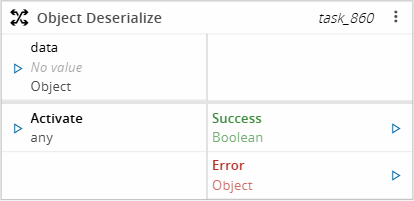
| data | Object | The object to extract the values from |
| Activate | any | Triggers task execution |
Outputs#
| Name | Data Type | Description |
|---|---|---|
<custom list> | <custom> | One output per configured entry, holding the extracted value converted to the configured type |
| Success | Boolean | Returns true if the task completes successfully |
| Error | Error | Contains information about any error that occurs |
Settings#
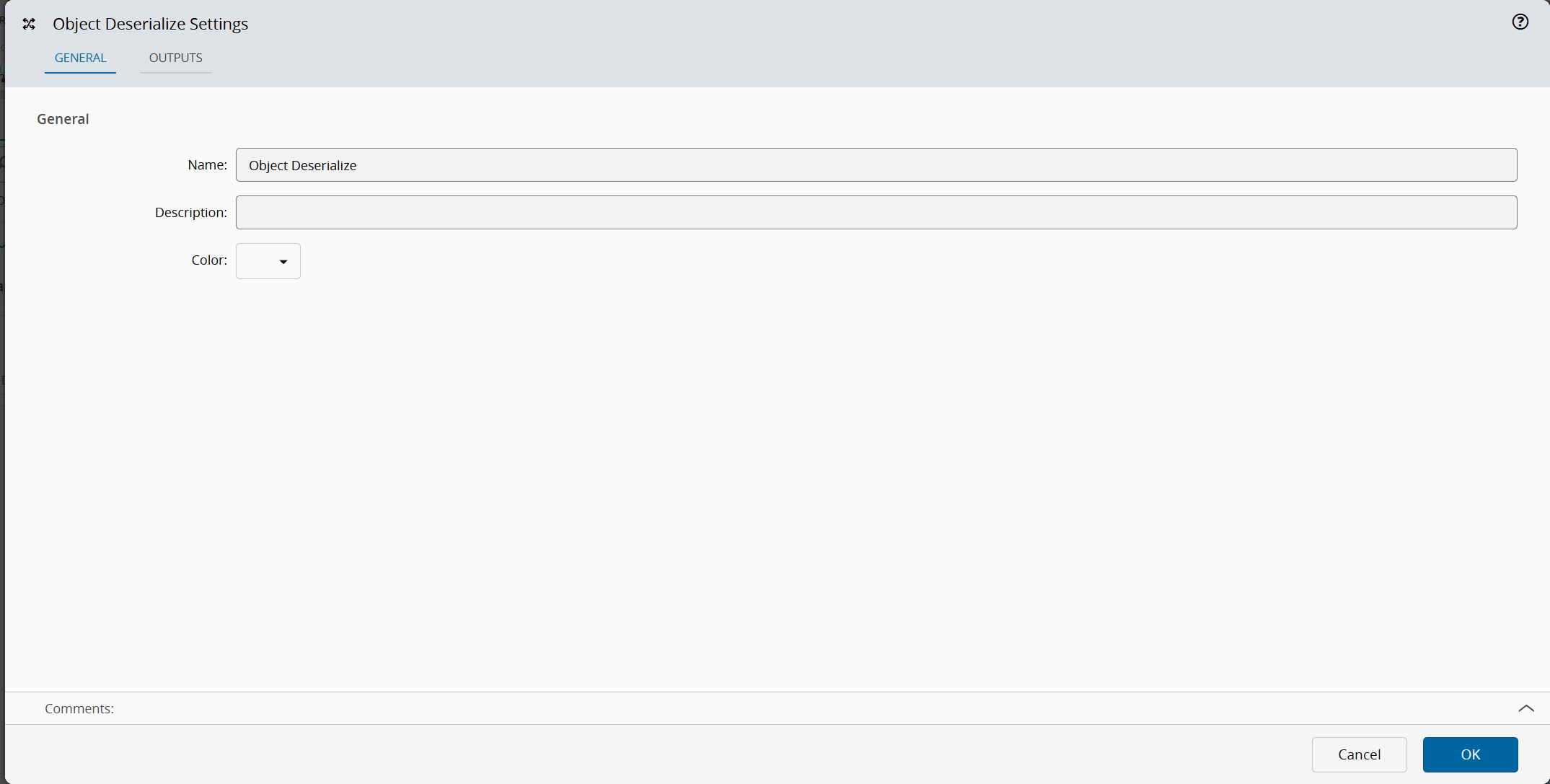
The Outputs Tab includes the following settings:
| Name | Data Type | Default Value | Description |
|---|---|---|---|
| Name | String | Output Name. This value is required | |
| Type | ComplexType | Any | Data type the extracted value is converted to. This value is required |
| Expression | Text | Dot-separated path to the value inside the object. This value is required | |
| Default Value | String | Value emitted when the path resolves to no value | |
| Mandatory | Boolean | false | When enabled, the task fails if the path resolves to no value |
Behavior#
Path expressions#
The Expression setting is a dot-separated path, where each segment is a property name. Array elements are read by their numeric index, used as a path segment:
| Expression | Reads |
|---|---|
equipment | The equipment property at the root of the object |
equipment.name | The name property of the equipment object |
readings.0.value | The value property of the first entry of the readings array |
Table: Object Deserialize path expression examples
Bracket notation, such as readings[0].value, is not supported. An expression with an empty segment, such as equipment..name, is invalid.
Resolution of each output#
For every configured output, the task reads the path and then:
- When the path resolves to a value, the value is converted to the configured type and emitted.
- When the path resolves to no value and the output is mandatory, the task emits an error and stops. A default value does not rescue a mandatory output in this case.
- When the path resolves to no value and a default value is configured, the default value is converted to the configured type and emitted.
- When the path resolves to no value and no default value is configured, the output is not emitted at all. The task continues with the remaining outputs.
If the path itself is invalid, or the conversion to the configured type fails, the configured default value is used. When there is no default value, the task emits an error and stops.
Note
An empty Default Value is treated as no default value. To emit an empty string, extract it from the object instead.
The task emits the Error output, and no other output, when the input object is null.
Order of emission#
All outputs are resolved before any of them is emitted. This means that a failure on one output prevents the earlier outputs from being emitted, so a workflow never observes a partially deserialized object.
Examples#
Extract nested and array values#
Configure the following outputs on the Outputs tab:
| Name | Type | Expression |
|---|---|---|
| equipmentName | String | equipment.name |
| firstReading | Number | readings.0.value |
When the data input receives:
equipmentName emits "Oven-01", firstReading emits 21.5, and Success emits true.
Fall back to a default value#
Configure a single output:
| Name | Type | Expression | Default Value |
|---|---|---|---|
| status | String | equipment.status | Unknown |
When the data input receives:
The status path does not resolve to a value, so status emits "Unknown" and Success emits true.
Fail on a missing mandatory output#
Configure:
| Name | Type | Expression | Mandatory |
|---|---|---|---|
| serialNumber | String | equipment.serialNumber | true |
When the data input receives:
The serialNumber path does not resolve to a value. Since the output is mandatory, the task emits Error with a message that includes "Mandatory output 'serialNumber' not found at path 'equipment.serialNumber'", and no other output is emitted — even if a Default Value had been configured for this output.
Fail when the input object is null#
Configure any output, for example:
| Name | Type | Expression |
|---|---|---|
| equipmentName | String | equipment.name |
When the data input receives null, the task does not attempt to resolve any output. It emits Error with the message "Input object is null or undefined", and no other output is emitted.