SQL Server Always On#
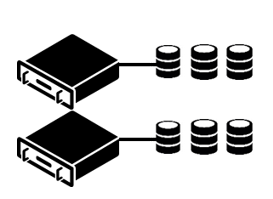
Always On is a feature that provides a low-cost alternative to a Storage Area Network (SAN) as each Database Server uses its own local storage as shown in the figure below. The Always On feature is supported in the SQL Server Enterprise and Standard Editions (the Standard Edition does not support Availability Groups and is limited to two nodes Failover Cluster Instances). More information about SQL Server Always On can be found in the following URLs:
SQL Server Always On Failover Cluster Instances#
The Always On Failover Cluster Instances leverages Windows Server Failover Clustering (WSFC) functionality to provide local high availability through redundancy at the server-instance level - a failover cluster instance (FCI). A FCI is a single instance of SQL Server that is installed across different Windows Server Failover Clustering (WSFC) nodes and, possibly, across multiple subnets. On the network, an FCI appears to be an instance of SQL Server running on a single computer, but the FCI provides failover from one WSFC node to another if the current node becomes unavailable
SQL Server Always On Availability Groups#
The Always On Availability Groups feature is a high-availability and disaster-recovery solution that provides an enterprise-level alternative to database mirroring. Always On Availability Groups maximize the availability of a set of user databases for an enterprise. An availability group supports a failover environment for a discrete set of user databases, known as availability databases, that fail over together. An availability group supports a set of read-write primary databases and one to eight sets of corresponding secondary databases. Optionally, secondary databases can be made available for read-only access and/or some backup operations.