Create Material#
 Material.Create
Material.CreateTemplate
Material.CreateFromTemplate
Overview#
The operation is used to create a Material. A template can also be created using a similar procedure and there is also the possibility of using a template to create the new object as well. This selection can be done in the main entity menu.
Sequence of Steps#
Step 1: General#
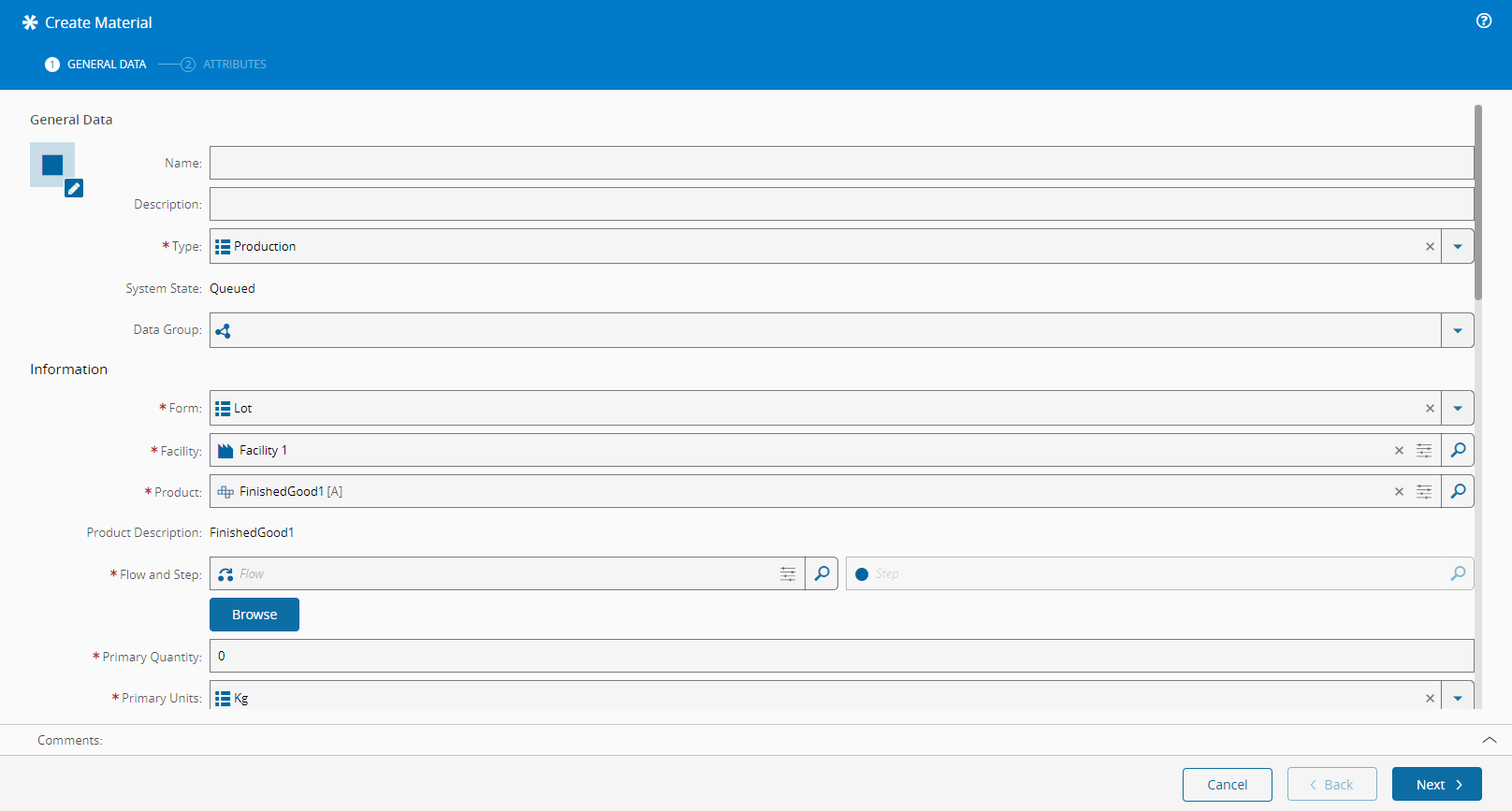
- Enter the Material name. The name can be left blank if there is a name generator configured to provide unique Material names.
- Optionally, enter a Material description.
- Select the Material type. The list of possible values is taken from the lookup table MaterialType.
- Select the State Model and the initial State Model state (by default the initial State Model state of the selected State Model is taken).
- Select the Material form. The list of possible values is taken from the lookup table MaterialForm.
- Select the Material Facility.
-
Select the Material Product:
- If there is a default Flow Path associated with the Product or its Product Group , the default Flow Path is automatically pre-selected for the Material but it can be overridden by the user.
Info
If the Step where the Material will be created has the Print Material Labels Automatically property set to
true, that information will be displayed on the bottom section of the wizard.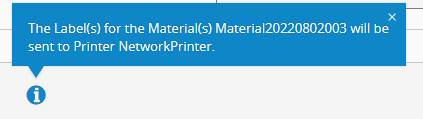
- If the selected Material Product has configured characteristics, a Characteristics step is enabled (see below).
-
Select the Bin Code for the Material (when the selected Product requires one).
- Specify the quantities of the Material - note that the Step will determine the primary and secondary units of the Material if the Step Set Units property is true. If the Step Set Units property is false, the user must specify manually the primary and optionally the secondary units for the Material. Note that the quantities can only be decimal in the Step Is Decimal Quantity Allowed property is true and the Product Is Discrete property is false. The cost of the Material will be displayed if enough information is available to make the calculation.
- Optionally, specify the Material expiration date - an expired Material cannot be used as a consumable. The expiration date is checked in the following transactions: Assemble Material, Disassemble Material, Replace Assembled Material, Attach Material as Consumable, Combine Material, Compose Material and Prepare Material Transfer.
- If desired, enter information on the Manufacturer and Supplier, including Part and Lot Number, Date Code and Purchase Order Number.
- If needed, set the Restriction of Hazardous Substances Directive (RoHS) compliance flag.
- Define the Moisture Sensitivity Level for the Material.The list of possible values is taken from the lookup table MoistureSensitivityLevel.
- Define the number of remaining hours of Floor Life of the Material.
- Define the Floor Life Counter State:
- Running - if the Material is still within the defined Floor Life Time (Floor Life remaining time is higher than zero)
- Stopped - if the Floor Life time has already expired
- Define the Floor Life Open Date.
- Specify the priority of the Material (1 to 10).
- Specify whether Splits are allowed for the Material.
- Specify whether Merges are allowed for the Material.
- Check the Hot checkbox to indicate that the Material is a hot lot. A hot lot is always placed at the top of the dispatch lists and has the highest priority when used in scheduling.
- Check the Exclude From Scheduling checkbox to exclude the Material from Scheduling.
- Optionally, specify the Production Order for the Material.
- Optionally, define the Order number (free text) for the Material.
- Optionally, specify the Material possible start date, used for scheduling purposes only.
- Optionally specify the Material due date.
- Specify the Target Material Quantity. Value must be higher than 0. If defined, the Target Quantity Units field also needs to be defined.
- Optionally specify the Target Material Units for the Material.
- Define the Capacity Class for the Material. The list of possible values is taken from the lookup table CapacityClass.
-
Select Create to complete the operation or Next to define Characteristics.
Step 2: Characteristics#
-
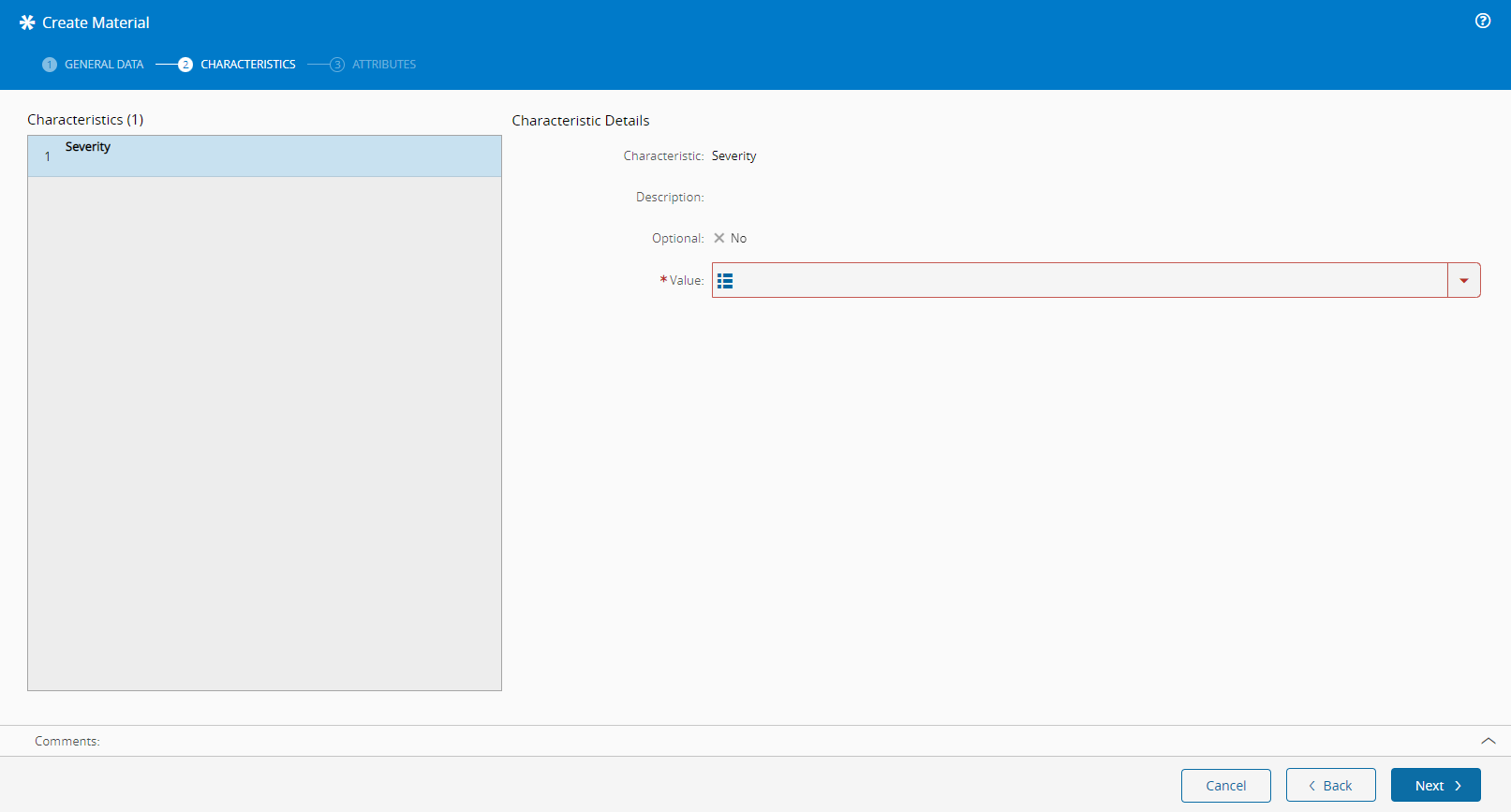
Specify the Value - this applies because the selected Material Product has Characteristics configured to
True, so you have to specify the Value for the mandatory configurable characteristics.Note
The Value of the Material Characteristic must be a value from the respective Product Characteristic Source Lookup Table.
-
Select Create to complete the operation.