Scheduling Machine Types#
Scheduling supports three different Scheduling Machine Types:
- Machine
- Batch
- Tunnel
Machine#
A Resource of Scheduling Type Machine is a Resource that processes a single Material at a time and does not have a capacity limitation, that is, there is no limitation to the quantity in a single Material that may be loaded into a Machine.
Characteristics#
- Number of Materials concurrently: one.
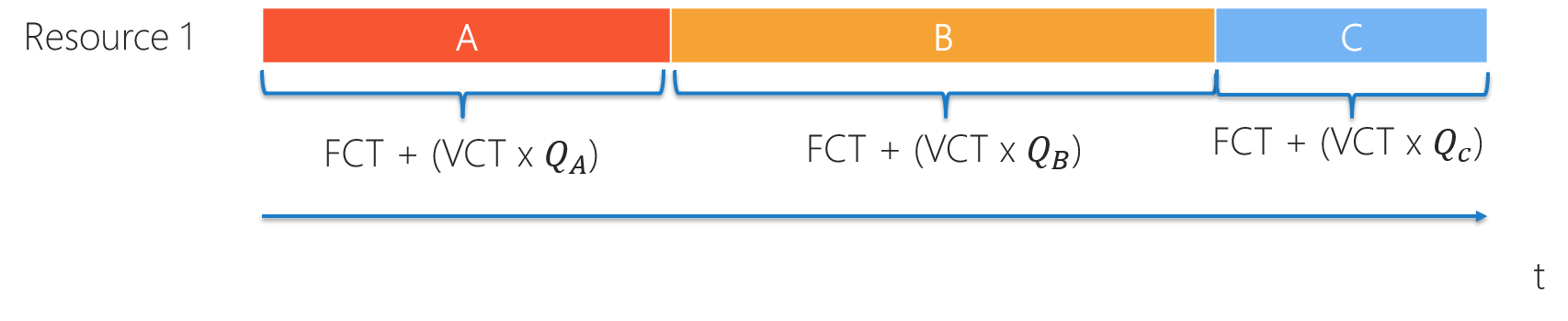
- Total processing time: Fixed Cycle Time + (Quantity x Variable Cycle Time).
- Setup time: Defined setup time for the Material, either through Setup Matrixes or through the Resource's Default Setup Time property.
- Capacity: no limitation capacity.
Requirements#
- The Resource Process Times table must provide either the fixed and variable cycle times or both for each required context.
Example#
The picture below shows Materials A, B and C being processed in a sequence in a Resource of Scheduling Type Machine (no setup times considered).
Batch#
A Resource of Scheduling Type Batch is a Resource that can process a certain number of Materials simultaneously. As such, depending on the capacity of this Resource, it may be possible to batch together multiple Materials to be processed at once, or it may required that a certain Material be split into multiple successive batches. When a batch of Materials is placed on this type of Resource, the operation will go on for as long as the longest fixed process time of its Materials, and cannot be interrupted to load/remove Materials. This model is exemplified by an oven.
Characteristics#
- Number of Materials concurrently: multiple, processed simultaneously.
- Total processing time: maximum of the Fixed Cycle Time for all the Materials in one batch.
- Setup time: Default Setup Time defined at the Resource level.
- Capacity: capacitated, the capacity gives the available volume within the Resource.
- Compatibility: Materials can only be batched if their Services are compatible.
Requirements#
- This type of Resource requires that the Resource Process Times smart table provides the fixed cycle time for each required context.
- In terms of capacity, it is necessary for the Products of all Materials to be processed in a Batch Resource to have their Capacity Class properties filled in; afterwards, the Resource Capacity smart table must be filled in, detailing in the Capacity field how many units of a certain Capacity Class fit in the Resource at once.
- In terms of compatibility:
- Materials with the same Service can always be batched together.
- Materials with Services that are compatible can always be batched together.
- Materials that are not in any of the previous situation cannot be batched together.
Example#
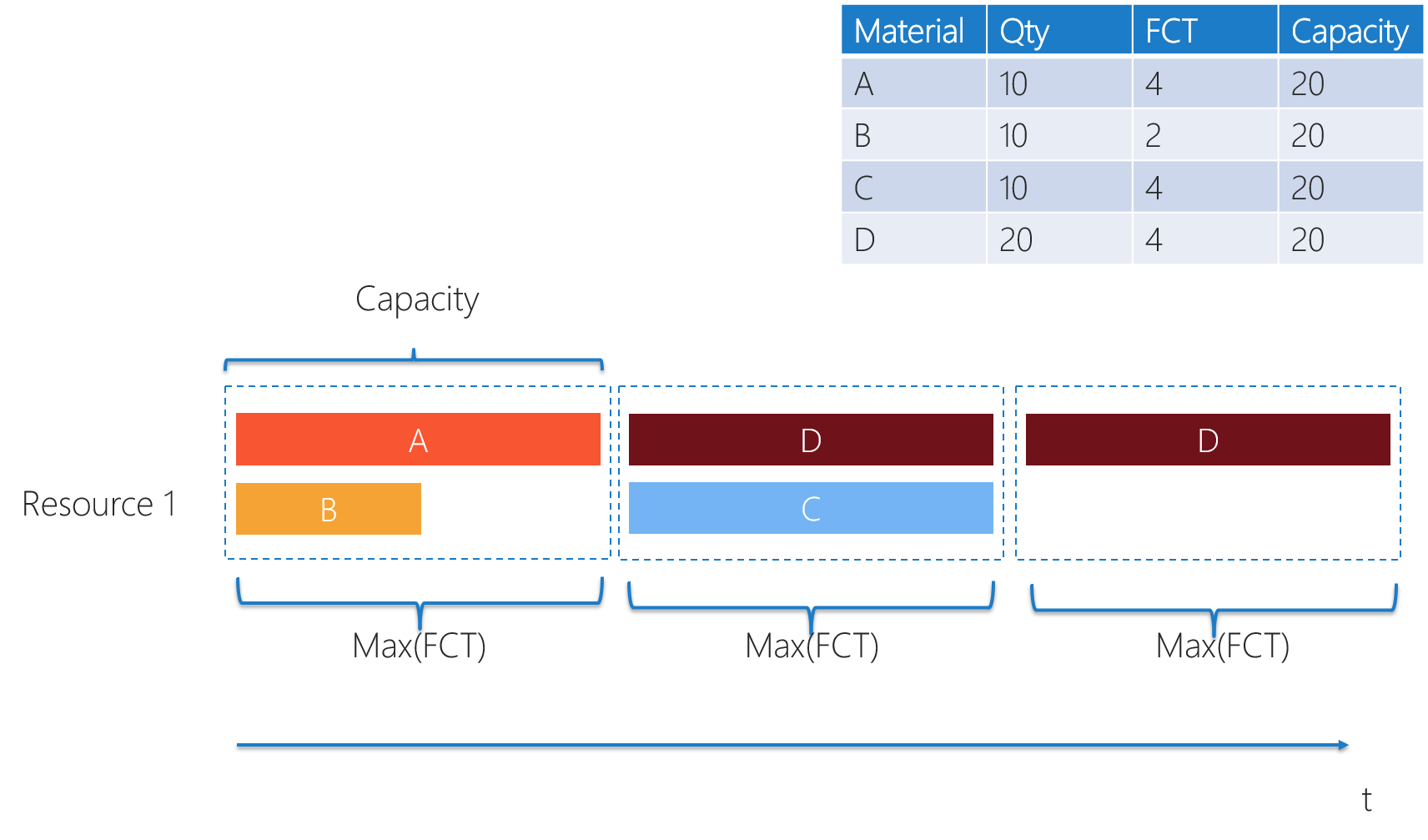
The picture below shows the processing of four Materials within a batch Resource, assuming that all Materials are compatible. Note that:
- For the first batch, the entire batch takes the longest processing time, that of Material A.
- For the second batch, since it is not possible to load all of Material D, given that half of the capacity was already taken by Material C, Material D is split between two batches.
Additional configurations#
Since there may be a high energy cost associated with the activation of a batch Resource (for example, a industrial oven), it may be desirable to guarantee that any batch formed will occupy at least a certain level of the Resource's Capacity. This is possible using the Resource property Minimum Batch Capacity Usage: by defining a percentage here, scheduling will only be able to create batches with at least this level of capacity occupation (it is a hard constraint).
On the other hand, by activating the Schedule property Schedule Batches in risk, this constraint may be violated if by scheduling a batch with a capacity occupation level it will be possible to fullfil the Due Date of a Material which would otherwise be impossible.
Tunnel#
A Resource of Scheduling Type Tunnel is a Resource that processes multiple Materials continuously like a conveyor belt. The ability to process uninterruptedly is given by the Service compatibility. This is also a capacitated Resource, as there is a limited length of conveyor belt to fit Materials: this determines, one the one hand, how much quantity/how many Materials can occupy the Tunnel Resource at once, and on the other, the processing time for each Material.
Characteristics#
- Number of Materials concurrently: multiple, processed sequentially with overlap (one Material may be being loaded into the conveyor as another Material is exiting).
- Total processing time: Variable Cycle Time x (1 + Quantity / Capacity). The Variable Cycle Time is time a unit takes being processed within the conveyor.
- Setup time: Defined setup time for the Material, either through Setup Matrixes or through the Resource's Default Setup Time property. Note that using the Default Setup Time may lead to the setup time being applied when the changeover is between compatible Services (for more information, check the Scheduling Setup page/).
- Capacity: capacitated, the Capacity gives the available length within the Resource.
- Compatibility: Materials can only occupy the conveyor simultaneously if their Services are compatible.
Requirements#
- The Resource Process Times table must provide the variable cycle times for each required context, which corresponds to how much time each unit spends inside the tunnel.
- In terms of capacity, it is necessary for the Products of all Materials to be processed in a tunnel Resource to have their Capacity Class properties filled in; afterwards, the Resource Capacity context resolution table must be filled in, detailing in the Capacity field how many units of a certain Capacity Class fit in the conveyor's length at once.
- In terms of compatibility:
- Materials with the same Service can occupy the conveyor simultaneously.
- Materials with the Services that are compatible can occupy the conveyor simultaneously.
- Materials that are not in any of the previous situation cannot occupy the conveyor simultaneously (the first Material must exit the tunnel completely before the second Material begins being loaded).
Example#
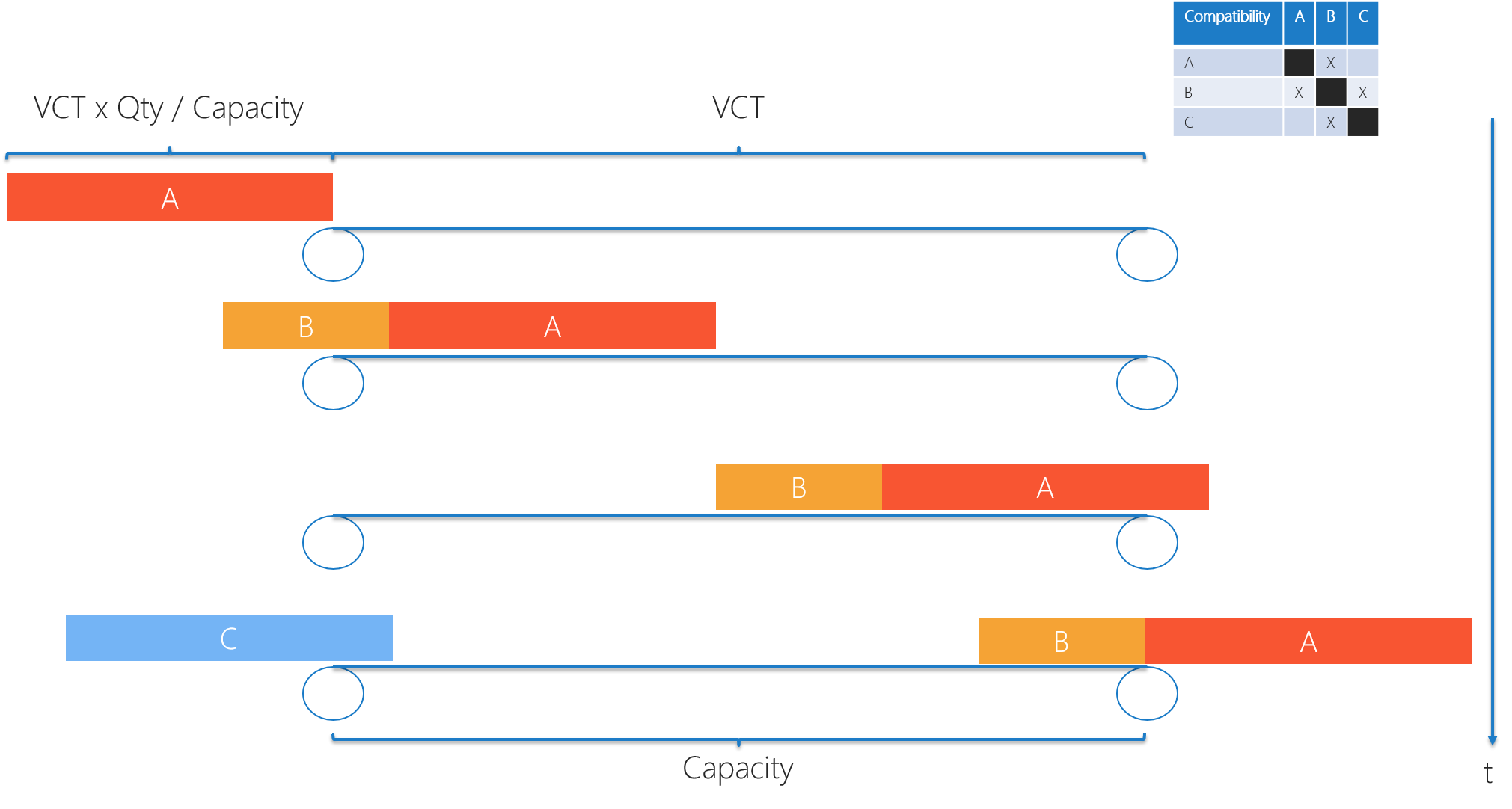
The picture below shows the processing of three Materials within a tunnel Resource, with their compatibility being shown in the matrix on the top left. Note that:
- Since Materials A and B are compatible, B can begin being loaded into the Resource before A has completely left. This, however, is not true for Material C which, being incompatible with A, must wait for A to completely exit the Tunnel (it is, however, compatible with B, meaning it can be loaded while B is still in the Tunnel).
- Since the Variable Cycle Time is the time a unit takes traveling between the start and the end of the conveyor, it will take this time for the first unit of a Material to reach the end of the tunnel. From then on, the rate at which each unit exits the Resource is (Variable Cycle Time)/Capacity, taking in total Quantity x (Variable Cycle Time)/Capacity. Summing these two times, we reach the Total Process Time of Variable Cycle Time x (1 + Quantity/Capacity).
Infinite Capacity#
Besides these previous models for the Resource, it is also possible to consider a Resource having Infinite Capacity. This means that any number of Materials may be processed there simultaneously, with the Total Processing Type for each Material being calculated similarly to a Machine Resource (Fixed Cycle Time + (Quantity x Variable Cycle Time)). This can be used for processes where there are no Resource Capacity and Availability Constraints, therefore, in practice, Scheduling will only apply a lead time between the previous and following steps.