---
alias: user-guide-automation-task-mes-materialtrackinrequest
tags:
- automation tasks
description: "Trigger task that listens for Material Track In requests from the MES and starts the equipment-side handling for the operation"
---
# On Material Track In Request
:iot-system-event-lg:
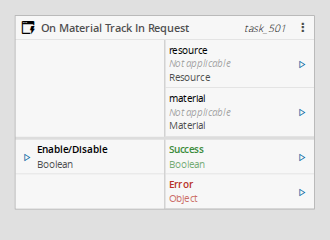
This **trigger** task listens for Material Track In requests coming from the MES and lets a workflow perform the equipment-side handling when an operator tracks a **Material** in at a **Resource**.
It belongs to the `System / MES` category, under `Triggers`, and is available in both Data Flow and Control Flow workflows. In a Control Flow workflow it appears as a `Start` trigger named `When a Resource performs Material Track In`.
## Details
| Fields | Details |
| ----------------- | ---------------------------------------------------------------------------------- |
| Scope | Connect IoT
Data Platform
Enterprise Integration
Factory Automation |
| Workflow | Data flow
Control flow |
| `IsProtocol` flag | :material-close:{style="color:#EF5350"} |
## Behavior
When an operator performs [[user-guide-track-in-material]], the MES sends a request on the `ConnectIoT.TrackIn.RequestReply` subject and waits for a reply. This task receives that request, emits the `resource` and the `material` involved in the operation, and emits `Success`.
The MES sends the request only when the **Resource** involved in the operation has the Enable Automation Scenarios and Material Track-In Interlocking properties enabled. The request is handled by the Automation Controller instance associated with the Resource or, when defined, with its Automation Scenarios Owner Entity.
The MES stays blocked until a reply is sent. If none is sent within the `Reply Timeout`, the task emits `Error` and the track in fails on the MES side.
The reply is produced differently depending on the workflow type:
- **Control Flow** - the reply is the result of the trigger's handler branch.
- **Data Flow** - a downstream [Send Material Track In Reply](task_material_track_in_reply.md) task sends the reply.
## Inputs
| Name | Data Type | Description |
| -------------- | --------- | ---------------------------------------------------------------------------------------------------------------------- |
| Enable/Disable | `Boolean` | Enables (`true`) or disables (`false`) the message listener at runtime. Works together with the `Auto Enable` setting. |
Table: On Material Track In Request task inputs
## Outputs
| Name | Data Type | Description |
| ------------ | ------------ | ------------------------------------------------------ |
| resource | `Resource` | The Resource where the operation is being performed. |
| material | `Material` | The Material being tracked in. |
| Success | `Boolean` | Triggered when a request is received and processed. |
| Error | `Error` | Triggered when the task fails or the reply times out. |
Table: On Material Track In Request task outputs
## Settings
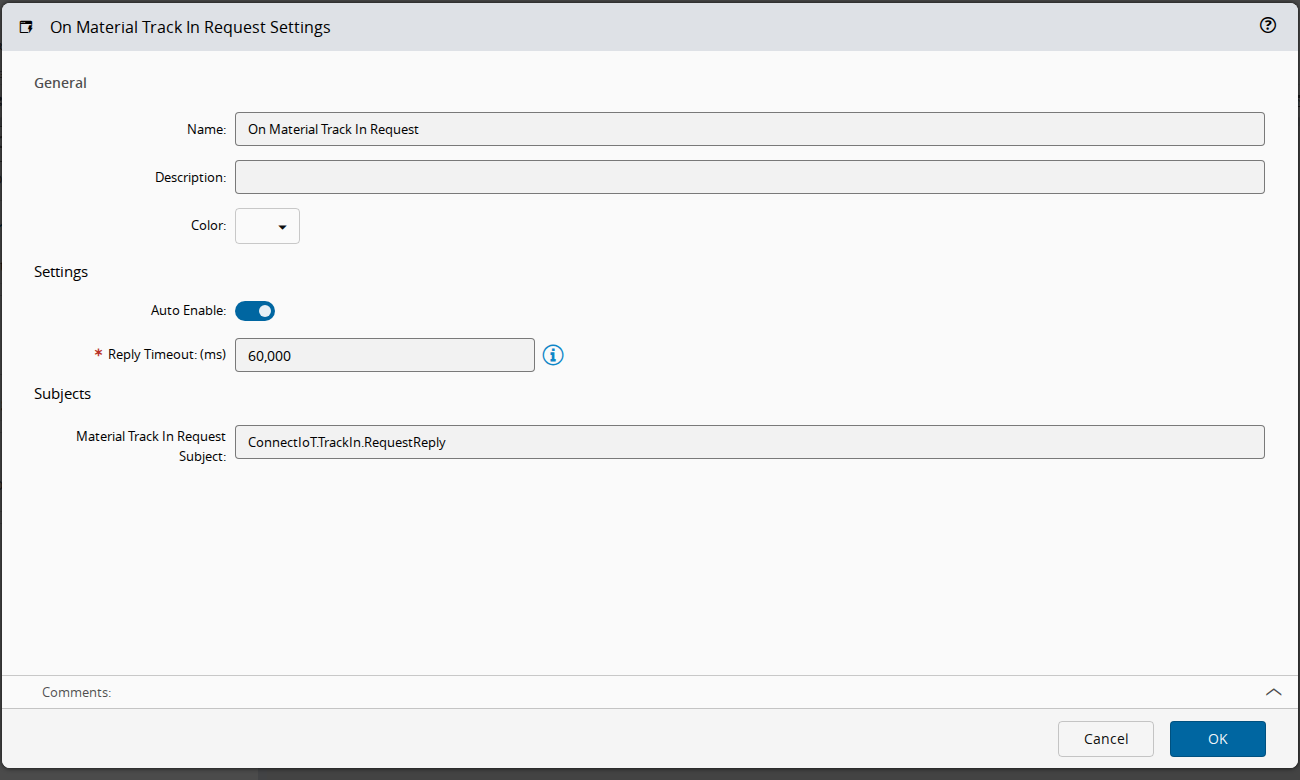
On the `General` tab, you have the usual settings and the following settings:
| Name | Data Type | Values | Default | Description |
| ------------------------ | --------- | ------ | ------------------------------ | ----------------------------------------------------------------------------------------------- |
| Auto Enable | `Boolean` | | `true` | Automatically enables the message listener when the task starts. |
| Reply Timeout | `Integer` | ms | `60000` | Amount of time allowed to wait for a reply before issuing a timeout. This setting is mandatory. |
| Material Track In Request Subject | `String` | | `ConnectIoT.TrackIn.RequestReply` | Subject used to communicate with the MES. This setting is read-only. |
Table: On Material Track In Request task settings
## Remarks
This task pairs with the [Send Material Track In Reply](task_material_track_in_reply.md) task, which sends the reply back to the originating request.
This task uses a specific structure of context-based data called `zone`. More information on this topic can be read in the [Zones](../zones.md) page.